Resources & Media
Background Image: Generic Banner


FOR IMMEDIATE RELEASE
FOR MORE INFORMATION CONTACT:
Brian Reil
202-508-5514
FOR MORE INFORMATION CONTACT:
Brian Reil
202-508-5514
New EEI Podcast: Analysis Finds U.S. Electricity Rates Have Remained Stable in Majority of States
New EEI Podcast: Analysis Finds U.S. Electricity Rates Have Remained Stable in Majority of States
Charles River Associates Report Finds U.S. Electricity Rates Largely Track Inflation, With Data Centers Not Driving Cost Increases
WASHINGTON (February 02, 2026) — The Edison Electric Institute (EEI) today released a new episode of its Electric Perspectives podcast featuring EEI President and CEO Drew Maloney and Matt DeCourcey, vice president of the Energy Practice at Charles River Associates (CRA). During the conversation, they discussed CRA’s new analysis of U.S. electricity rates and what the data reveals about electricity rate trends, regional factors, and the role of data centers.
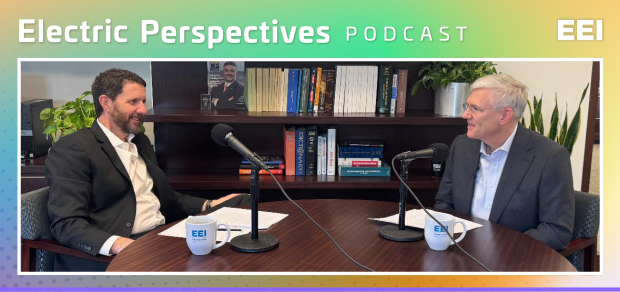
In the episode, Maloney and DeCourcey reflected on:
- Rate stability across most of the nation: “For most U.S. electricity customers, retail rates have generally remained stable,” said Maloney. “EEI’s member companies continue to work with regulators and policymakers to advocate for policies that keep customer bills as low as possible across the country, and the report highlights that electric companies are doing an effective job managing the costs that they can control.”
- What national averages miss: “The national average rate doesn’t really reflect reality for most customers,” said DeCourcey. “[There were] rate increases in a small handful of states [due to] regional dynamics… In fact, something like 34 states had changes in their rates that were less than the national average."
- Why data centers are not driving rate increases: “There is no evidence to support the idea that data centers have made rates go up,” said DeCourcey. “We found that there is this emerging set of principles in regulation and rate making that is designed very specifically to prevent [cost increases] … and require data centers to pay their full cost of service.
- How new large loads benefit existing customers: “If you have a new sort of large load customer [such as a data center] show up on the grid and it is paying its own costs, it’s also going to absorb some of the shared costs [of maintaining and operating the grid]. That’s going to benefit the customers that are already there,” said DeCourcey.
Read the full study here and the press release here. Among the report’s key findings:
- Over the last five years, 34 states—68% of states—experienced below-average electricity rate increases.
- In general, higher rate increases can be attributed to external drivers and operating expenses—such as wholesale price increases, wildfire spending, and net metering programs.
- Data centers are not driving up rates, with the exception of some areas served by the PJM Interconnection. New data center tariffs and agreements are expected to insulate existing customers from the costs of serving data centers.
Click here to listen to the full podcast, and explore our latest episodes below:
- Powering Data Centers While Delivering Value to All Customers – featuring Entergy Mississippi President and CEO Haley Fisackerly and Amazon Web Services Head of Energy and Water for the Americas Brandon Oyer
- Powering Data Centers in the Age of AI – featuring Ed Baine, executive vice president of Utility Operations and president of Dominion Energy Virginia, and Martin Hermann, CEO of BrightNight
- Why Permitting Reform Matters for America’s Energy Future – featuring EEI President and CEO Drew Maloney and President of ITC Holdings Krista Tanner
- Scaling AI in the Energy Industry – featuring Arizona Public Service Chief Information Officer Michelle Ferrara and Bidgely Chief Growth Officer Karthik Moorthy
The Electric Perspectives podcast discusses the latest trends and issues shaping the electric power industry. Each episode features an interview with guests including leaders from EEI and our member companies, government and industry partners, and energy thought leaders and experts. Click here to listen to more episodes and subscribe wherever you listen to podcasts.
About EEI
About EEI
EEI is the association that represents all U.S. investor-owned electric companies. Our members provide safe, reliable electricity for nearly 250 million Americans, and operate in all 50 states and the District of Columbia. Collectively, the electric power industry supports more than 7 million jobs in communities across the United States and drives economic growth and prosperity. EEI also includes hundreds of industry suppliers and related organizations as Associate Members.